How to Choose the Right Home Charger for Your EV
Last reviewed: July 21, 2026
Match Your Home Charger to Your Vehicle and Driving Needs
Choosing a home EV charger involves more than matching a plug to a vehicle. Charging equipment varies in power, features and installation requirements, while electric vehicles differ in battery capacity, connector type and the amount of AC power they can accept.
The most powerful charger is not automatically the best charger for every home or vehicle. A higher-output unit cannot make an EV charge faster than the vehicle’s onboard charging system permits. It may also require electrical capacity that the home cannot easily provide.
The right charger should bring three things into balance:
- The vehicle’s charging capabilities
- The home’s available electrical capacity
- The driver’s actual charging needs
Understanding how those factors work together can prevent unnecessary installation costs while ensuring the vehicle is ready when it is needed.
The Vehicle Sets an Important Charging Limit
When an EV is connected to Level 1 or Level 2 equipment, the home supplies alternating-current electricity. The vehicle’s onboard charger converts that AC electricity into the direct-current energy stored in the battery.
Every EV has a maximum rate at which its onboard charger can perform this conversion. If a vehicle has a 7.4-kilowatt onboard charging limit, connecting it to equipment capable of supplying 11.5 or 19.2 kilowatts will not make that vehicle charge at the equipment’s maximum output.
The actual charging rate is governed by the lowest applicable limit among:
- The electrical circuit
- The charging equipment
- The vehicle’s onboard charger
For example, consider a vehicle with a 7.4 kW onboard charging limit connected to an 11.5 kW Level 2 charger. Even if the electrical circuit can fully support the charger, the vehicle will accept no more than approximately 7.4 kW.
Conversely, a vehicle capable of accepting 19.2 kW will not receive that much power from a charger and circuit limited to 9.6 kW. In that case, the home-charging system—not the vehicle—sets the limit.
Actual charging can also vary because of battery temperature, state of charge, vehicle settings and energy used for battery conditioning.
Charger Output and Circuit Size Are Related
Level 2 chargers are commonly described by amperage or kilowatt output. These measurements are related.
Approximate charging power can be calculated by multiplying voltage by amperage and dividing by 1,000. At a nominal 240 volts:
- 32 amps provides approximately 7.7 kW
- 40 amps provides approximately 9.6 kW
- 48 amps provides approximately 11.5 kW
- 80 amps provides approximately 19.2 kW
The electrical circuit must be designed for the charger’s continuous load. The breaker size is therefore greater than the charging amperage. For example, a charger configured to deliver 40 amps is normally associated with a larger circuit than the output alone might suggest.
These numbers illustrate why equipment should not be selected independently from the installation. A charger may advertise a high maximum output, but the electrician must configure it according to the circuit and available electrical capacity.
For a broader explanation of charging capacity, visit our guide to Level 2 home EV charging.
How Much Charging Speed Do You Actually Need?
The vehicle’s maximum capability is only one part of the decision. Your daily mileage and overnight parking time may be more important.
Suppose an EV can accept 11.5 kW, but the driver travels approximately 30 miles per day and normally parks at home for 10 hours. A lower-output Level 2 installation may still replace the day’s driving comfortably before morning.
A driver who regularly travels much farther, arrives home with a low battery or has only a short charging window may benefit more from additional capacity.
Ask these questions before choosing a charger:
- How many miles do you normally drive each day?
- How long is the vehicle parked at home?
- How often do you arrive with a low battery?
- Do you need to recharge between trips?
- Is workplace or public charging regularly available?
- Might a second EV be added later?
The goal is not necessarily to recharge the battery from empty to full every night. For most drivers, the practical goal is to replace normal daily use with a comfortable reserve.
Battery Size Does Not Tell the Whole Story
A large battery often takes longer to recharge than a small one, but battery capacity alone does not determine the appropriate charger.
Two EVs with similarly sized batteries may have different onboard AC charging limits. A vehicle with a large battery and a high onboard limit may benefit from a higher-output Level 2 charger, especially when driven extensively. Another large-battery vehicle may be unable to use that additional output.
Plug-in hybrid vehicles present a different situation. Their batteries are generally smaller, and many can recharge overnight using Level 1 equipment. Installing a powerful Level 2 charger may provide limited practical benefit for the current vehicle, although it could prepare the home for a future fully electric model.
Our Level 1 versus Level 2 charging comparison can help determine which charging level fits your routine.
Confirm Connector Compatibility
The charger’s vehicle connector must be physically compatible with the EV.
Common North American home-charging connectors include J1772 and the North American Charging Standard, commonly called NACS. Vehicle manufacturers are changing connector strategies, and adapters may be available for certain vehicle-and-charger combinations.
Before purchasing equipment, confirm:
- The connector used by the current vehicle
- Whether an adapter is required
- Whether the adapter is approved for the vehicle and equipment
- The connector expected on a future vehicle
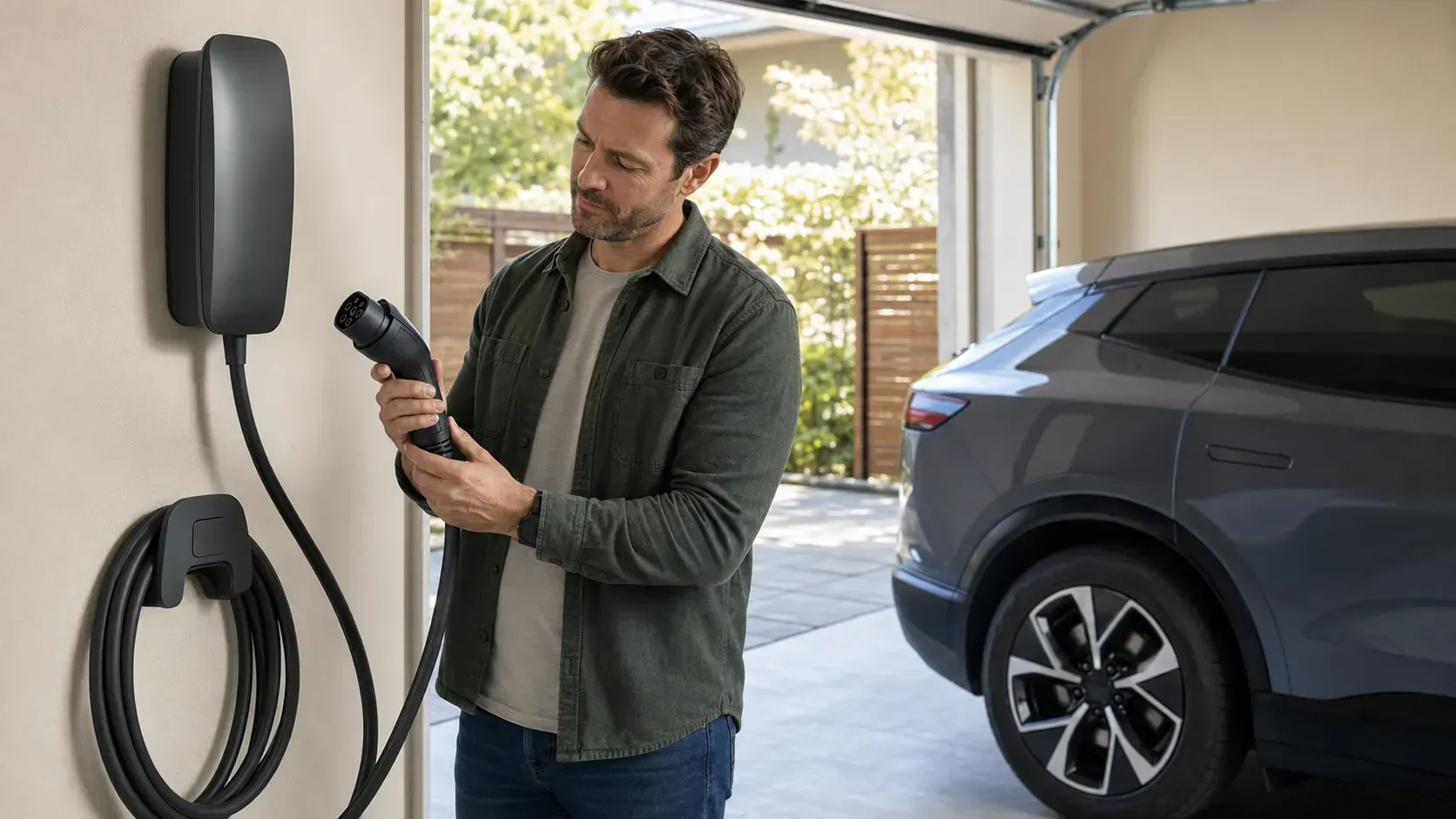
- Whether the cable comfortably reaches the charge port
A compatible connector does not guarantee maximum charging speed. Connector compatibility determines whether the equipment can connect to the vehicle; the electrical circuit, charger output and onboard charging limit determine how quickly AC charging can occur.
Because standards and manufacturer support can change, verify compatibility using current information from the vehicle and charger manufacturers.
Consider Where the Vehicle’s Charge Port Is Located
Charge-port placement varies considerably. It may be near the front, rear, driver’s side or passenger’s side.
The charger should be positioned so its cable reaches the vehicle without being stretched, driven over or routed through a regular walking path. Think about how the vehicle is normally parked and whether backing into the garage is practical.
Cable length is especially important if:
- More than one vehicle may use the charger
- A future EV may have its port on the opposite side
- The charger is installed outdoors
- The parking space is unusually long
- The charger cannot be mounted beside the vehicle
A carefully selected charger in the wrong location can still create daily frustration. Equipment choice and mounting location should therefore be planned together.
Smart Features May Influence the Decision
Many Level 2 chargers include Wi-Fi connectivity, scheduling, energy reporting, notifications and remote controls. Some can coordinate charging between two vehicles or adjust output around household electrical demand.
Before paying for connected features, determine whether the vehicle already provides similar functions. Many EVs allow owners to set charging schedules, monitor charging status and establish charge limits through the vehicle or its mobile application.
A smart charger may be especially useful when:
- The homeowner wants equipment-level energy reports
- Multiple people use the charger
- Access needs to be controlled
- Two chargers share available capacity
- Dynamic load management is required
- Charging must be coordinated with utility-rate periods
Smart features also depend on reliable connectivity. Confirm that Wi-Fi coverage is adequate at the proposed charger location.
Read more about smart EV chargers, scheduling and home energy management.
Can the Electrical Panel Support the Charger?
A vehicle capable of high-rate AC charging does not mean the home can automatically provide that rate.
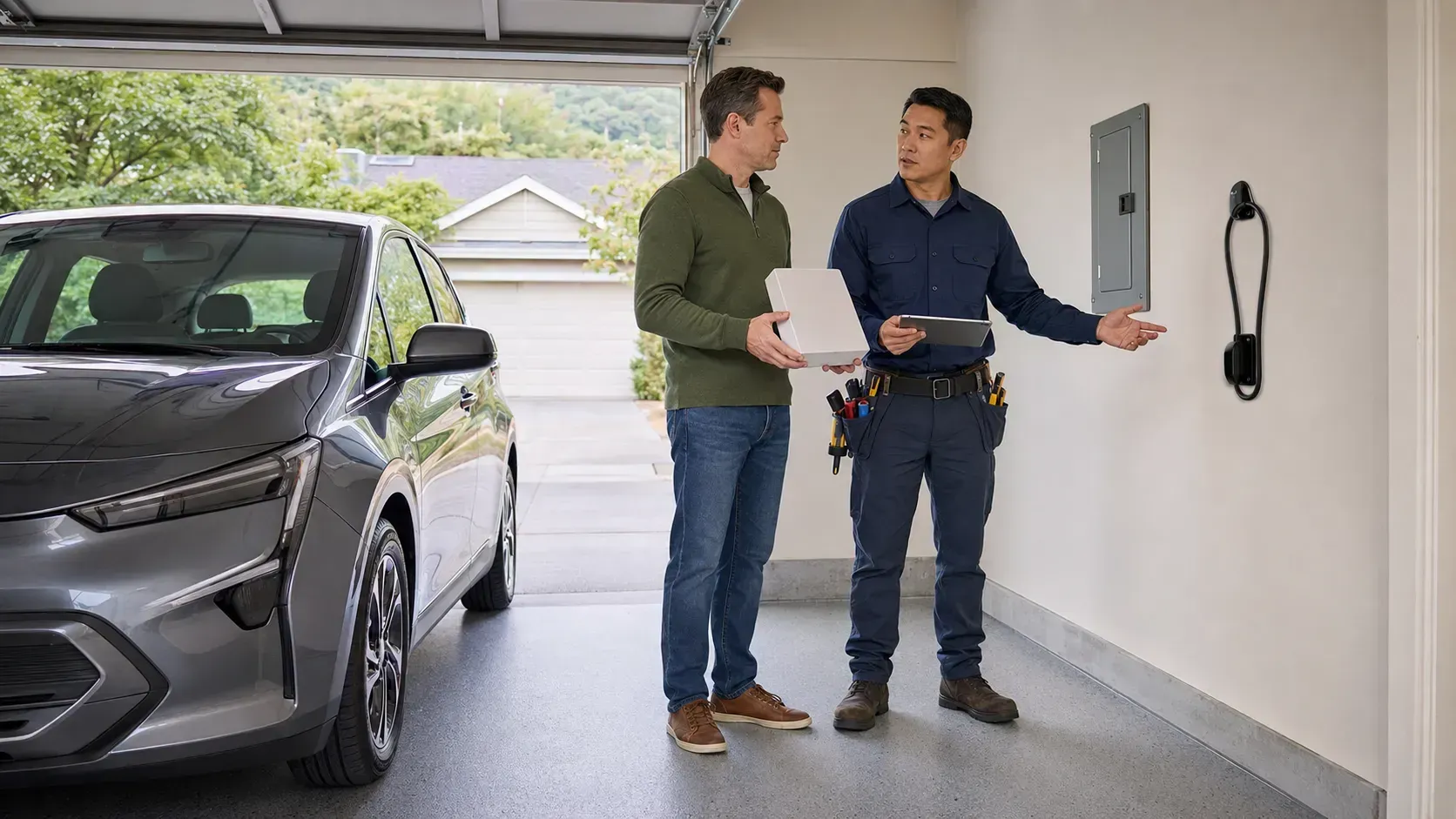
An electrician should evaluate the electrical service, panel capacity and existing household loads. Major equipment such as air conditioning, electric heating, water heating, cooking appliances, laundry equipment, pools and spas can affect the available capacity.
If the home cannot support the charger at its maximum output, possible solutions may include:
- Configuring the charger for a lower output
- Selecting a lower-capacity charger
- Installing approved load-management equipment
- Adding or replacing a panel
- Upgrading the electrical service
A lower charger setting may still satisfy the driver’s daily needs. In some homes, load management can provide useful charging without immediately undertaking a major service upgrade.
Learn what is involved in an EV charger electrical panel assessment.
Plug-In or Hardwired Equipment?
Some Level 2 chargers connect through a compatible 240-volt receptacle. Others are hardwired directly to the circuit.
Plug-in equipment may be easier to remove or replace, but it requires a suitable receptacle and installation. Hardwired equipment eliminates the plug-and-receptacle connection and is frequently considered for outdoor or higher-output installations.
The equipment instructions, charger output, installation location and applicable electrical requirements all influence the decision. A homeowner should not assume that an existing receptacle is suitable merely because the charger’s plug fits.
A qualified installer can determine the appropriate connection method for the selected charger and location.
Think Beyond the Current Vehicle
A charger may remain in service longer than the EV currently parked in the garage. It is reasonable to consider future needs, but future-proofing does not always mean installing the highest possible output.
Useful preparation might include:
- Selecting equipment with adjustable amperage
- Choosing a cable that can reach different charge-port locations
- Planning for a second vehicle
- Installing conduit that supports a future circuit change
- Preserving panel space
- Considering load-management capability
- Selecting equipment with replaceable or adaptable connections
The best strategy depends on the home and the likelihood of future changes. Spending substantially more for capacity that cannot be used may not be worthwhile, but ignoring foreseeable needs can create avoidable work later.
Compare the Complete Installation, Not Just the Charger
The charger’s retail price is only one component of the project. The final installation may also include:
- A dedicated circuit
- Breaker and conductors
- Conduit or cable routing
- Equipment mounting
- Permit and inspection
- Panel modifications
- Outdoor-rated components
- Trenching or restoration
- Load-management equipment
Before purchasing hardware, discuss the proposed unit with the installer. This helps prevent ordering equipment that is incompatible with the circuit, vehicle, location or desired installation method.
Our guide to EV charger installation costs in Santa Rosa explains the major cost variables.
Choose the System as a Whole
The right home charger is not simply a product selected from a list. It is one part of a charging system that includes the vehicle, electrical circuit, panel, cable location and driver’s daily routine.
A well-matched installation should:
- Support the vehicle’s useful charging capability
- Replace normal daily driving within the available time
- Fit the home’s electrical capacity
- Reach the vehicle conveniently
- Provide only the features the household will use
- Leave reasonable flexibility for future vehicles
Contact us to discuss your EV, daily mileage, electrical system and preferred charging location. We can help identify the charging capacity and equipment features that make sense for your Santa Rosa home.
Contact Us
Contact Us - Blog - Choose the right Charger