Level 1 vs. Level 2 Charging: Which is Right for Your Home?
Last reviewed: July 21, 2026
Level 1 or Level 2: Choosing the Right Home EV Charging Setup
Choosing between Level 1 and Level 2 charging is one of the first decisions a new electric-vehicle owner faces. Level 1 is inexpensive and may require little or no new equipment, while Level 2 provides much faster charging and greater flexibility.
The best choice is not necessarily the fastest charger available. It is the charging setup that reliably replaces your daily driving, works with your home’s electrical system and fits your plans for the future.
For some Santa Rosa households, an existing 120-volt outlet may be entirely adequate. For others, a professionally installed 240-volt Level 2 charger can make EV ownership substantially more convenient.
What Is Level 1 EV Charging?
Level 1 charging uses a standard 120-volt household circuit. Many electric vehicles include a portable charging cord that can connect the vehicle to a compatible household receptacle.
According to the U.S. Department of Energy, Level 1 charging commonly adds approximately 2 to 5 miles of range per hour. Actual performance varies with the vehicle, charging equipment, temperature and other conditions.
Because Level 1 is relatively slow, it works best when the vehicle remains parked for long periods. A car connected for 10 hours might recover enough energy for a modest daily commute, even if it does not completely recharge a large battery.
Level 1 may be a practical choice for:
- Plug-in hybrid vehicles
- Drivers with relatively low daily mileage
- Households with access to workplace charging
- Vehicles that remain parked overnight
- A second EV that is driven infrequently
- Homeowners who do not yet need faster charging
Its primary advantage is simplicity. If an appropriate circuit and receptacle are already available, the homeowner may not need to install a separate 240-volt charging circuit.
That does not mean every existing outlet is suitable. EV charging places a continuous load on the circuit for many hours. The receptacle should be properly grounded, in good condition and supported by wiring and protection appropriate for the load. An extension cord should not be used as a permanent charging solution.
Learn more in our guide to Level 1 home EV charging.
What Is Level 2 EV Charging?
Level 2 charging uses a 240-volt circuit, similar in voltage to circuits used for some large household appliances. The equipment may be hardwired or connected to a compatible 240-volt receptacle, depending on the charger, location and installation requirements.
Level 2 charging commonly adds approximately 10 to 30 miles of range per hour, according to the U.S. Department of Energy. The vehicle’s onboard charger and the electrical circuit determine the actual charging rate.
A Level 2 charger can often restore a typical day’s driving in a few hours and recharge a substantially depleted battery overnight. This makes it the preferred home-charging option for many fully electric vehicles.
Level 2 may be the better choice for:
- Drivers with longer daily commutes
- Fully electric vehicles with larger batteries
- Households that need predictable overnight charging
- Drivers who frequently return home with a low battery
- Homes with two electric vehicles
- People who make multiple trips during the day
- Homeowners preparing for future EVs
Explore the equipment and installation considerations in our Level 2 home EV charging guide.
How Much Range Do You Need to Recover Each Night?
Battery size alone should not determine the charging level. Your normal daily mileage is often more important.
Suppose a driver travels approximately 25 miles on an average day and the vehicle is parked at home for 10 or 12 hours overnight. Level 1 may be capable of replacing much or all of that daily driving before morning.
A driver who regularly travels 70 or 80 miles, arrives home late and leaves early will have less time to recover more range. Level 2 is likely to provide a more comfortable margin.
Consider these questions:
- How many miles do you drive on a typical day?
- How many hours is the vehicle normally parked at home?
- How often do you arrive with a low state of charge?
- Can you charge at work or another regular destination?
- Do you need to recharge between trips on the same day?
- Might a second EV be added to the household?
You do not necessarily need to recharge the battery from empty to full every night. Most homeowners need a charging system that consistently replaces their regular daily use.
Charging Speed Is Limited by the Vehicle
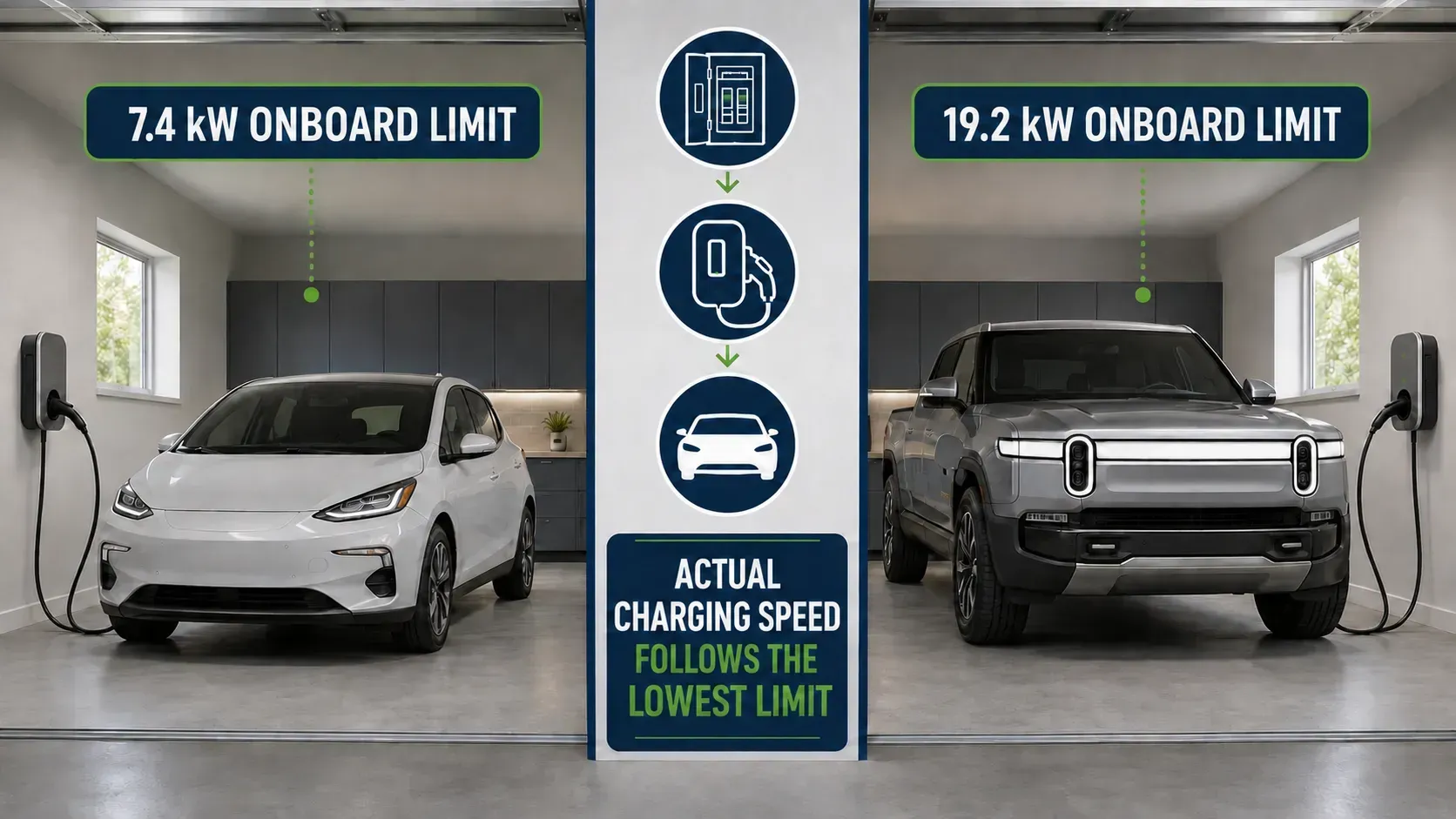
A high-capacity Level 2 charger cannot force a vehicle to accept electricity faster than its onboard charging system allows.
For example, connecting a vehicle with a lower AC charging limit to a higher-output charger will not produce the charger’s maximum advertised speed. The vehicle and charger communicate, and charging occurs at the lowest applicable limit established by the vehicle, equipment or electrical circuit.
This is why charger selection should begin with the vehicle’s specifications and the homeowner’s driving requirements. Paying for the largest possible circuit may provide little immediate benefit if the vehicle cannot use the additional capacity.
There may still be a reason to install greater capacity for a future vehicle, but that should be a deliberate planning decision.
Electrical Requirements Are Very Different
Level 1 and Level 2 charging place different demands on a home.
Level 1 ordinarily uses a 120-volt circuit. Before relying on an existing receptacle, an electrician may need to confirm that the outlet and circuit are in suitable condition and that other loads will not interfere with reliable charging.
Level 2 generally requires a dedicated 240-volt circuit sized for the selected charging output. The installation may include a new breaker, conductors, conduit, receptacle or hardwired connection, permit and final inspection.
An unused breaker position does not by itself confirm that the panel can support a Level 2 charger. The home’s total electrical load must also be considered.
Major loads may include:
- Heating and air conditioning
- Electric water heating
- Cooking equipment
- Clothes dryers
- Pools or spas
- Solar and battery equipment
- Other planned electrification projects
Some homes can support Level 2 charging without significant changes. Others may need a lower charger setting, load-management equipment, a subpanel or an electrical-service upgrade.
Our guide to EV charger electrical panel assessment explains what should be evaluated.
Level 1 Is Not Always the Less Expensive Long-Term Choice
Level 1 usually has the lowest initial installation cost when a suitable outlet already exists. However, cost should be considered alongside convenience and the household’s transportation needs.
If Level 1 cannot reliably replace daily driving, the homeowner may need to use public charging more frequently. That can add inconvenience and may cost more per unit of energy than charging at home.
Level 2 requires a larger initial investment, but it can provide more control over when the vehicle charges. Faster home charging may make it easier to schedule charging during favorable utility-rate periods rather than charging continuously whenever the vehicle is parked.
The amount of energy required to recharge the vehicle does not automatically increase simply because Level 2 supplies it faster. Electricity cost is primarily determined by how much energy the vehicle receives, the applicable utility rate and when charging occurs.
For a detailed discussion of project variables, see how much it costs to install an EV charger in Santa Rosa.
Smart Features Are Usually Associated With Level 2
Many Level 2 chargers offer Wi-Fi connectivity, scheduled charging, usage reports, notifications and remote controls. Some can coordinate two vehicles or adjust charging around other household electrical loads.
These features can help homeowners:
- Shift charging to preferred hours
- Track electricity consumption
- Confirm that charging has started
- Limit access to the charger
- Manage available power
- Coordinate charging between two EVs
Some vehicles provide scheduling and status features through their own software, so a connected charger is not necessary for every household.
If smart features are important, also consider the quality of the Wi-Fi signal near the garage or outdoor charging location. Read more about smart EV chargers and home energy management.
Can a Home Use Both Level 1 and Level 2?
Yes. A household with two plug-in vehicles may use Level 2 for the vehicle with greater daily mileage and Level 1 for a plug-in hybrid or less frequently driven EV.
Another option is a charging system that shares available electrical capacity between two Level 2 connections. Rather than both vehicles charging at maximum output simultaneously, the system distributes power according to its configuration and household demand.
The right arrangement depends on each vehicle’s usage, when they are parked and the home’s available electrical capacity. Two vehicles do not automatically require two maximum-capacity circuits.
Which Charging Level Is Right for Your Home?
Level 1 is worth considering when:
- Daily mileage is modest
- The vehicle is parked for long periods
- You drive a plug-in hybrid
- An appropriate 120-volt circuit is available
- Faster charging would provide little practical benefit
Level 2 is generally the stronger choice when:
- Daily mileage is moderate or high
- You drive a fully electric vehicle
- Overnight charging time is limited
- You want greater scheduling flexibility
- More than one EV is expected
- You want a long-term home-charging solution
The decision should account for the vehicle, driving routine, parking location and electrical system together.
Evaluate the Home Before Selecting the Charger
Before purchasing charging equipment, identify how much range must be recovered, where the vehicle will park and what the electrical system can safely support.
A professional assessment can determine:
- Whether an existing Level 1 outlet is suitable
- The practical Level 2 charging capacity
- Whether the panel has sufficient capacity
- The best charger and cable location
- Whether load management could be useful
- What permits and inspections are required
- The expected installation scope and cost
The goal is not to install the fastest possible charger. It is to create a safe, convenient charging setup that supports the way you drive.
Contact us to discuss your vehicle, daily mileage and Santa Rosa home. We can help you determine whether Level 1 is sufficient or whether Level 2 installation is the better long-term solution.
Contact Us
Contact Us - Blog - Level 1 vs Level 2